
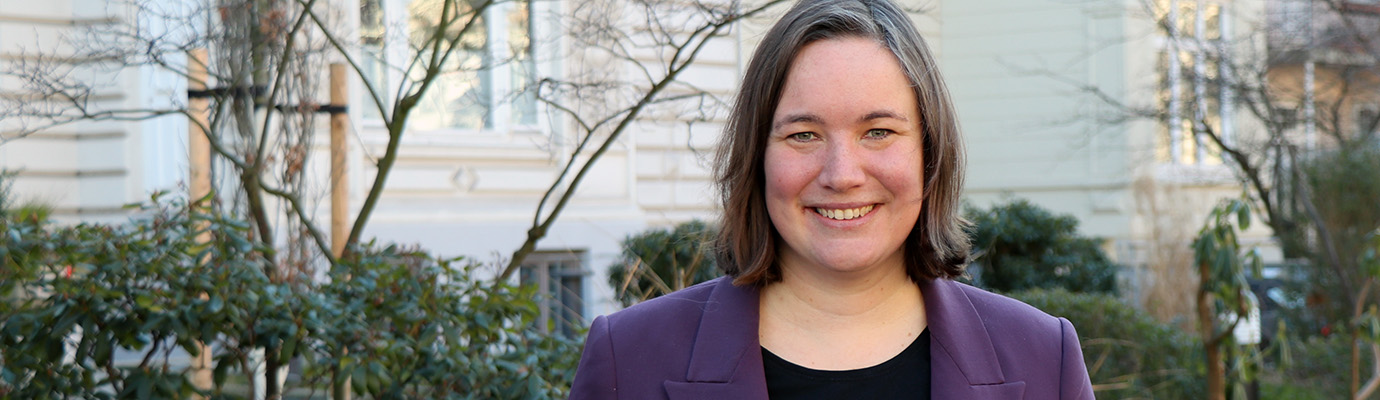
Prof. Dr. Judith Möller

Scientific Director

Judith Möller has taken up the professorship “Empirical Communication Research, especially Media Use and Social Media Effects” at Universität Hamburg in cooperation with the Leibniz Institute for Media Research | Hans-Bredow-Institut (HBI) on 1 February 2023. This is a joint appointment, which combines teaching at the University’s Institute of Journalism and Communication Studies with extensive research activities at the HBI.

Her research focuses on the effects of political communication, especially in social media. The focus is on two questions: (1) the impact of personalised political communication on individuals and society as a whole, and (2) the role of (new) media in the process of opinion formation, especially as part of political socialisation processes.

Judith Möller war Associate Professor of Political Communication at the Department of Communication Studies, University of Amsterdam (UvA) and Associate Professor at the Department of Sociology and Political Science, University of Trondheim before. She is an associate member of the Amsterdam School of Communication Research (ASCoR), the Center for Politics and Communication (CPC) and the Information, Communication, & the Data Society Initiative (ICDS).

In 2019, Judith Möller received a VENI Talent Track grant from the Netherlands Science Foundation (NWO). The project is entitled “Vocal, Visible and Vaulting? (Dis)connected Niche Audiences in the Age of Artificial Intelligence” and investigates the impact of algorithmic filtering systems and artificial intelligence on specific populations and niche audiences. Her work has been published in numerous international journals. She is a member of the editorial board of the Journal of Communication and Political Communication and an ad hoc reviewer for leading journals in the field.

Transfer

The transfer of her research and collaboration with practitioners is of great importance to Judith Möller. She regularly participates in public debates or science festivals and is in constant dialogue with newspaper publishers, public broadcasters and media regulators. For the German media authority Medienanstalten, she contributed to an expert opinion on types of disinformation and misinformation, which looked at different forms of disinformation and their dissemination from a communication science and legal perspective. She is also regularly invited as an expert to meetings of media regulators and consumer and market authorities, such as the European Regulators Group for Audiovisual Media Services (ERGA), the European Platform of Regulatory Authorities (EPRA), Medienanstalt Berlin-Brandenburg (mabb), Landesanstalt für Medien NRW, the Swiss Federal Media Commission (EMEK) or Election Observation and Democracy Support (EODS).

Contact information

Prof. Dr. Judith Möller

Scientific Director

Leibniz Institute for Media Research | Hans-Bredow-Institut
Warburgstraße 30b
20354 Hamburg

Last update: 28.01.2026

Works by Prof. Dr. Judith Möller

Cover of the book
Publikation Article Published in Handbook

Growing Up in Data-Intensive and Automated (Media) Environments

Dr. Claudia Lampert examines changing usage practices and possible implications for socialization research in the chapter “Growing Up in Data-Intensive and Automated (Media) Environments” of the handbook “Media Socialization in ‘Smart’ Environments. Self- and Social Development in the Context of Datafication and Automation,” edited by Laura Sūna and Wolfgang Reißmann.

Tastatur mit einer goldfarbenen Taste, die ein weißes Abzeichen zeigt
Beitrag Media Research Blog Post

Algorithmic Amplification of Negative Discourse as a Systemic Risk

How does attention-economy-driven algorithmic amplification of conflict-driven and negative-emotional communication distort public discourse? And does this distortion constitute a systemic risk under the Digital Services Act (DSA)? This blog article refers to our previous blogpost on "Platform Badges for Civic Communication", explains why such interventions are needed, and outlines how they could address these systemic risks.

Mehrere Hände halten Smartphones, darüber stilisierte Symbole für KI, Uhr, Glühbirne und Weltkugel
Beitrag Safer Internet Day 2026

“He Just Does Everything Right. He’s Simply Smart” – Young People’s Perspectives on AI

AI applications are no longer used just for homework, but also as advisors and conversation partners. This blog post takes a look at young people's experiences with AI and shows that schools and parents often lack opportunities to discuss the role of AI in our daily lives. Safer Internet Day offers a good opportunity to start this conversation.

Cover of the report “Generative AI from the Perspective of Young People”
Publikation Publication on Safer Internet Day 2026

Generative AI from the Perspective of Young People

The use of generative AI, especially ChatGPT, is now firmly established among young people online. A study by Kira Thiel, Claudia Lampert and Eleysa Memis explores young people's views on generative AI, highlighting its significance in their daily lives.

Cover des Arbeitspapiers
Publikation Working Paper Available for Download

Public Service Media Enabling Dialogue

For the project “Dialog Formats in Public Service Media,” Magdalena Stratmann conducted a literature analysis on “The Role of Public Service Media as Enablers of Dialogue in Digitalized Societies.” This analysis is now available for download as a working paper.

Vorschau des Artikels von Christian Ollig auf epd Medien
Publikation Article for epd Medien

How the Digital Services Act (DSA) Regulates Platforms

U.S. politicians accuse the European Union of endangering freedom of expression with the Digital Services Act (DSA). However, media law expert Dr. Christian Ollig argues that the DSA actually protects users' opinions from arbitrary censorship by platform operators. It also gives users a legal basis to assert their freedom of expression against large platform operators at the European level.

Cover of the book
Publikation Contribution to an Anthology

Health Communication

Claudia Lampert, along with Prof. Dr. Eva Baumann and Dr. Bettina Fromm, published an article in the Health Sciences handbook that provides an overview of health communication. The handbook is now in its eighth edition.

Cover of the article written by Anna von Garmissen published on January 10th, 2026 on the media platform of epd Medien: "Gefährliche Abwärtsspirale. Zur Lage des Journalismus in Deutschland"
Publikation Article in epd Medien

Studies on the State of Journalism in Germany

What is the state of journalism in Germany? In her article for epd Medien, Anna von Garmissen discusses three recent studies on the state of journalism in Germany. According to von Garmissen, the findings are thought-provoking and, when considered together, should be alarming to all of us.

Hände tippen auf Laptop-Tastatur, darüber eingeblendete Symbole für Text, Dokument, Lupe und Auszeichnung mit Häkchen.
Beitrag Media Research Blog Post

Platform Badges for Civic Communication

How can platforms address distortions in the digital attention economy without restricting free expression excessively? This blog post explores how new incentive structures can promote constructive communication on digital platforms and the potential of the Digital Services Act to facilitate such interventions.

Cover of the Publication
Publikation Chapter in Anthology

Contextualized Repertoire Maps in Media Usage Research

In their article, Dr. Lisa Merten and Prof. em. Dr. Uwe Hasebrink present contextualized repertoire maps as a method for recording media repertoires based on a study on news usage and discuss their possibilities and limitations in media usage research. Their article is part of the anthology “Researching Media, Data, and Networking Practices: Methodological Concepts and Research Software.”

Publication by Jan-Ole Harfst in the special edition
Publikation Special Edition of the Bonner Rechtsjournal

Communication Risks in Online Environments

How can German democracy remain resilient in the face of the communicative threats posed by the digital space? Jan-Ole Harfst's article shows that communicative threats on the internet cannot be countered at the national level alone, but require supranational protection of democracy, and assesses the significance of the Digital Services Act in this context.

Publikation Internet Policy Review

Can Quality Badges Improve Communication on Online Platforms?

A seal of approval for civil communication could promote successful public communication on online platforms while respecting users'freedoms. In their article 'Platform Badges for Civic Communication. An Interdisciplinary Discussion of a Risk Mitigation Measure Pursuant to Art.', Jan Rau, Jan-Ole Harfst and Dr. Tobias Mast examine various design options for such seals.

1 2 3 11

Page 1 from 11

Newsletter

Information about current projects, events and publications of the institute.

Subscribe now