Capacities and Competences in Dealing with Hate Speech and Hostility towards Science (KAPAZ)

In recent decades, there has been an increase in the number of attacks on scientists through digital platforms for science communication and the political desire for more social impact. The climate debate of the past few years has made this phenomenon very clear. Most recently, researchers were at the centre of populist campaigns and hate speech during the Covid 19 pandemic. Online platforms reinforce this trend and provide a space to spread such negative statements quickly and with high visibility.

New Strategies for a Resilient Research System

Verbal attacks and threats against researchers on social media are a significant part of hostility towards science. They can have a negative impact on scientists’ willingness to engage with societal actors or to communicate their knowledge publicly. Therefore, it is particularly important to prevent hostility towards science and attacks on researchers. However, there is a lack of effective resources, strategies, and measures to deal with these attacks and their effects at the level of both individual scientists and institutions. Consequently, capacities and competencies are needed for researchers and scientific institutions to deal with modern forms of hostility towards science.

Central Contact Point for Researchers and Research Institutes

The aim of the project was to make the science system more resilient and adaptable to current developments. To this end, the KAPAZ project network developed a range of different content and structures:

  • Robust knowledge base on the topic of hostility to science
  • Helpdesk for affected researchers based on the knowledge on hostility to science
  • Guidelines for capacity and competence building at scientific institutions
  • Inter-university train-the-trainer programme for communication officers
  • Summer school for young researchers

Project partners

  • Alexander von Humboldt Institute for Internet and Society (HIIG) – Network coordinator
  • Berlin School of Public Engagement and Open Science (BSOPE)
  • Bundesverband Hochschulkommunikation (BV_HK)
  • Freie Universität Berlin (FU)
  • German Centre for Higher Education Research and Science Studies (DZHW)
  • Leibniz Institute for Media Research│Hans-Bredow-Institut (HBI)
  • Wissenschaft im Dialog (WiD)

Project Details

Overview

Project start: 2023; Project end: 2025

Programme Area: Program Area 2 Communication Structures and Their Governance

Persons involved

Third-party funder

VolkswagenStiftung

Contact information

Similar projects & publications

Cover of issue 14 / 2026 of the journal "Media and Communication"
Open Access Publication

Can the Quality of Online Discussions Be Automatically Assessed—and Improved?

In their publication, Patrick Frey, Cornelius Puschmann (ZeMKI, University of Bremen), Smita Bhattacharya, and Gregor Wiedemann (HBI) explore whetherAI can measure the quality of online discussions. The study demonstrates that AI can identify violations of norms and serve as a tool for crafting counterarguments tailored to specific debates.

Cover of the current issue of the magazine “KJug” (3/2026)
New KJug Issue Has Been Published

Protecting Children and Young People in an Increasingly Digitalized World

In the latest issue of KJug, Claudia Lampert presents the EU Kids Online research consortium's findings on how children and adolescents view a potential social media ban. Kira Thiel shares insights from her dissertation, which examines how adolescents cope with problematic online experiences and the strategies they use to manage them.

Nonfiction Book Cover: No Child's Play
Recently Published!

No Child’s Play – Protecting Minors in the Digital Age

In his nonfiction book, Stephan Dreyer analyzes the complex field of youth media protection. Through his examination of legal regulations, actual usage, and technological developments, he offers valuable insights for individuals involved in this topic in the realms of practice, administration, politics, and academia.

Zwei Jugendliche, zu sehen von hinten oben, sitzen auf einer Mauer und blicken auf ein Handy
New DFG Research Project

Safeguarding Epistemic Trust in Adolescents: Conceptual Approaches and Policy Options

The interdisciplinary DFG project, “SETA: Protecting the Epistemic Trust of Adolescents: Conceptual Approaches and Policy Options,” conducted in collaboration with the Weizenbaum Institute, examines the state’s obligation to protect the epistemic trust of 13- to 17-year-olds without infringing on freedom of expression and information.

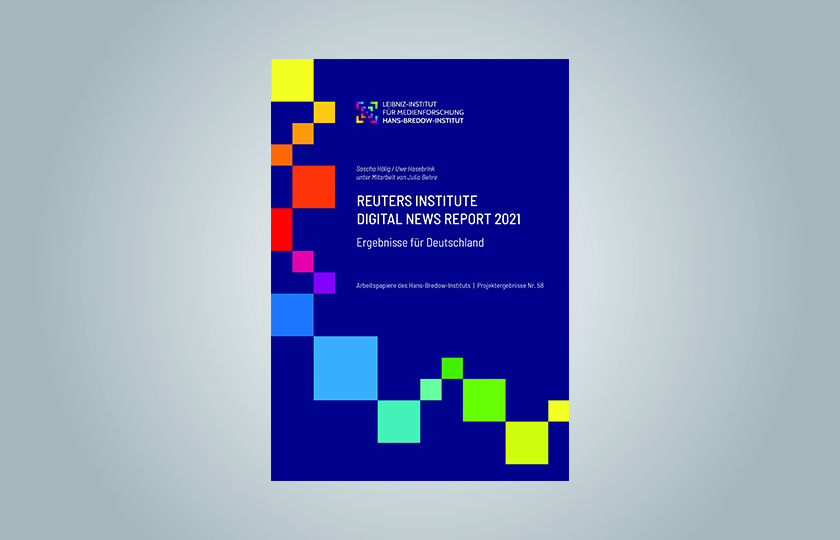
Cover des Arbeitspapiers Reuters-Bericht 2021
Report for Download

Reuters Institute Digital News Report 2021

The Reuters Institute Digital News Report, which provides an international comparison of news consumption, is being published for the tenth consecutive year.

Cover der Zeitschrift der Leibniz Gemeinschaft - Ausgabe 2/2026 zum Thema "Medizin"
Click Consultation

Consultation with Dr. Insta

The latest issue of the Leibniz Association’s magazine, which is part of the Science Year 2026, focuses on the topic of “Medicine.” Claudia Lampert, head of the Health Communication research group at the HBI, is interviewed about health influencers.

Cover
Open Access Publication

German Public Broadcasting Corporations in the Age of Streaming Platforms and AI

In her Friedrich Ebert Foundation publication project, Magdalena Stratmann describes how public service broadcasting in Germany addresses the challenge of fulfilling its legal mandate amid drastically changed conditions in the digital information ecosystem.

Cover der Studie
Recently Published!

Exploring GPT Representation of Journalistic Culture

The study by Prof. Dr. Wiebke Loosen et al. examines how large language models (LLMs) such as ChatGPT can reflect journalistic value systems. To this end, the GPT-4o model was asked to answer questions from the “Worlds of Journalism Study,” which explores perceptions of journalistic roles, theories of knowledge, and ethical principles.

Historische Aufnahme des hr-Funkhauses am Dornbusch aus den 50ern
Media History Project

The History of the Regional Public Broadcasting Corporation of the Federal State of Hesse in the Postwar Period

In January 2029, the Regional Public Broadcasting Corporation of the Federal State of Hesse (Hessischer Rundfunk) will celebrate its 80th anniversary. To mark the occasion, Dr. Hans-Ulrich Wagner is conducting scholarly research on its origins. His research focuses specifically on corporate history, personnel decisions, and programming policy in the postwar period.

Cover Arbeitspapier Nr. 84
Brief Report in English

Babies and Toddlers in Monetised Social Media Profiles

Stephan Dreyer, Claudia Lampert, and Kira Thiel published an English summary of their study on babies and toddlers in family-influencing content. They present their findings on how babies and toddlers (ages 0–5) are depicted in German-language, commercially oriented social media profiles on Instagram, TikTok, and YouTube.

1 2 3 … 35

Page 1 from 35

Newsletter

Information about current projects, events and publications of the institute.

Subscribe now