Cornelius Puschmann

Professor at the University of Bremen

Cornelius Puschmann is Professor at the Centre for Media, Communication and Information Research (ZeMKI) at the University of Bremen with a focus on “Digital Communication” and Associate Researcher at the Leibniz Institute for Media Research │ Hans-Bredow-Institut (HBI). From October 2016 to September 2019, he was a senior researcher at the institute and coordinated the postdoctoral research network Algorithmed Public Spheres (APS). Until October 2016 he worked as project manager at the Alexander von Humboldt Institute for Internet and Society (HIIG) in Berlin. There, he was involved in the “Networks of Outrage” project, which the Volkswagen Foundation supported as part of the “Science and Data Journalism” program. His areas of interest include hate speech, the role of algorithms in the selection of media content, and methodological aspects of computational social science.

Cornelius Puschmann completed his PhD at the University in Düsseldorf in 2009 with a corpus-based study on US-American corporate blogs and was subsequently a member of the junior research group “Science and Internet” (2010-2012). From 2012, he was a research assistant at the Institute for Information and Library Science (IBI) at the Humboldt University in Berlin, where he was responsible for the DFG project “Vernetzung, Sichtbarkeit, Information? Nutzungsmotive informeller digitaler Kommunikationsgenres unter Wissenschaftlern [Networking, Visibility, Information? Motives for Using Informal Digital Communication Genres among Scientists].” From January to July 2013, Cornelius Puschmann was a visiting scholar at the Oxford Internet Institute at Oxford University and, from September 2013 to August 2014, a visiting assistant professor at the Department of Media Studies at Amsterdam University. At the Zeppelin University in Friedrichshafen, he represented the Chair of Digital Communication in 2015/2016. From fall 2015 to fall 2016, he was Faculty Associate at the Berkman Klein Center for Internet and Society at Harvard University.

Cornelius Puschmann is co-editor of the 2014 volume “Twitter and Society” (Peter Lang) and member of the editorial board of the Journal of Broadcasting and Electronic Media.

His personal website is available at cbpuschmann.net.

Last update: 24.09.2026

Works by Cornelius Puschmann

Cover Stellungnahme Digitale Medien-Staatsvertrag
Available for Download

Expert Opinion on the State Treaty on Digital Media, Part 2

Wolfgang Schulz, Stephan Dreyer, Jasmin Hamid Habib, Matthias C. Kettemann, and Tobias Mast comment on the proposal by the State Broadcasting Commission regarding the “State Treaty on Digital Media, Part 2” (DMStV) in an expert opinion on the planned reform of the State Media Treaty and the State Treaty on the Protection of Minors in the Media.

First page of the article: The German Media Landscape Under the Control of Global Intermediaries
Article in Media Perspektiven

The German Media Landscape Under the Control of Global Intermediaries

The German media industry is growing, but it is primarily international platform companies that are benefiting from this trend. In the journal "Media Perspektiven", Lukas Barbutev, Tobias Mast, and Hendrik Theine analyze the consequences of the increasing market power of Google, Meta, and Amazon for the German media landscape.

Cover of the journal
Recently Published

M&K 3–4/2026 Has Been Published

The articles in issue 3–4/2026 of M&K address the architectural paradox of federated platforms (Simon Crins), a comparative analysis of media use among Danish and German police officers (Jochen Kinast / Johannes Riis, in English), and an exploratory typology of German fact-checkers (Johanna Radechovsky). All articles are available for download free of charge.

Cover of the journal "Journalism"
Open Access Publication

Arms Deliveries to Ukraine: Viewpoint Diversity in German Media

Gregor Wiedemann, Laura Liebig, and Katharina Kleinen-von Königslöw examined how German leading media outlets covered arms deliveries to Ukraine. Using AI-assisted content analysis, they evaluated articles from 14 leading German media outlets published in 2022 and 2023.

Cover des Routledge Handbook of News Agencies
Chapter in Routledge Handbook of News Agencies

The German Press Agency in the Routledge Handbook of News Agencies

Hans-Ulrich Wagner summarizes the key facts and the history of the German Press Agency (dpa) in his contribution. From its founding in the postwar period to the present day, he describes the agency’s defining values and principles, as well as the challenges it currently faces.

Cover of issue 14 / 2026 of the journal "Media and Communication"
Open Access Publication

Can the Quality of Online Discussions Be Automatically Assessed—and Improved?

In their publication, Patrick Frey, Cornelius Puschmann (ZeMKI, University of Bremen), Smita Bhattacharya, and Gregor Wiedemann (HBI) explore whetherAI can measure the quality of online discussions. The study demonstrates that AI can identify violations of norms and serve as a tool for crafting counterarguments tailored to specific debates.

Cover of the current issue of the magazine “KJug” (3/2026)
New KJug Issue Has Been Published

Protecting Children and Young People in an Increasingly Digitalized World

In the latest issue of KJug, Claudia Lampert presents the EU Kids Online research consortium's findings on how children and adolescents view a potential social media ban. Kira Thiel shares insights from her dissertation, which examines how adolescents cope with problematic online experiences and the strategies they use to manage them.

Nonfiction Book Cover: No Child's Play
Recently Published!

No Child’s Play – Protecting Minors in the Digital Age

In his nonfiction book, Stephan Dreyer analyzes the complex field of youth media protection. Through his examination of legal regulations, actual usage, and technological developments, he offers valuable insights for individuals involved in this topic in the realms of practice, administration, politics, and academia.

Zwei Jugendliche, zu sehen von hinten oben, sitzen auf einer Mauer und blicken auf ein Handy
New DFG Research Project

Safeguarding Epistemic Trust in Adolescents: Conceptual Approaches and Policy Options

The interdisciplinary DFG project, “SETA: Protecting the Epistemic Trust of Adolescents: Conceptual Approaches and Policy Options,” conducted in collaboration with the Weizenbaum Institute, examines the state’s obligation to protect the epistemic trust of 13- to 17-year-olds without infringing on freedom of expression and information.

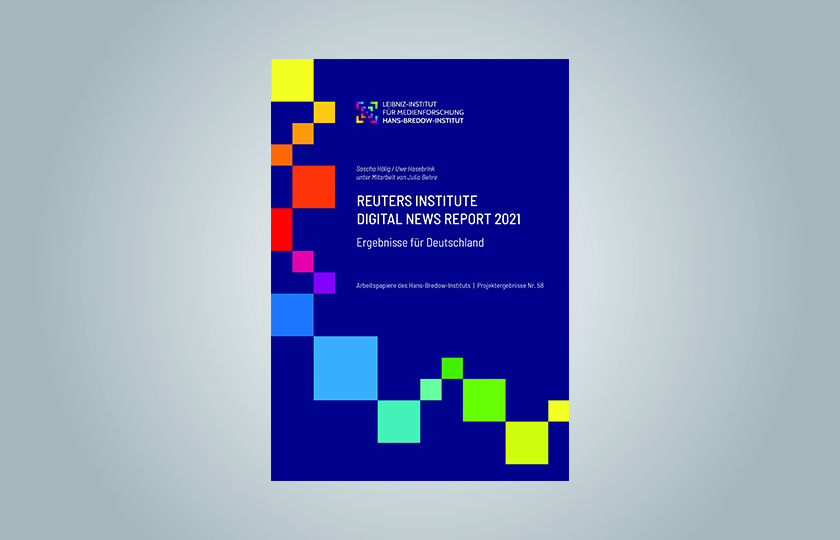
Cover des Arbeitspapiers Reuters-Bericht 2021
Report for Download

Reuters Institute Digital News Report 2021

The Reuters Institute Digital News Report, which provides an international comparison of news consumption, is being published for the tenth consecutive year.

Cover der Zeitschrift der Leibniz Gemeinschaft - Ausgabe 2/2026 zum Thema "Medizin"
Click Consultation

Consultation with Dr. Insta

The latest issue of the Leibniz Association’s magazine, which is part of the Science Year 2026, focuses on the topic of “Medicine.” Claudia Lampert, head of the Health Communication research group at the HBI, is interviewed about health influencers.

Blätter und bunte Zettel mit den Ergebnissen der Arbeiten von Gruppe 4, Gruppe 2 usw.
Article on the Media Research Blog

How Politically Empowered Do Young People Feel?

In a current project by Leonie Alatassi, students explore what political participation means to them, how it can be encouraged, and what barriers stand in the way. The first workshops show that many young people are eager to get involved. However, they need not only information, but also concrete support and opportunities to try things out and gain experience.

1 2 3 … 31

Page 1 from 31

Newsletter

Information about current projects, events and publications of the institute.

Subscribe now