History of the Regional Public Broadcasting Corporation of the Federal State of Hesse

In January 2029, the Regional Public Broadcasting Corporation of the Federal State of Hesse (Hessischer Rundfunk) will celebrate its 80th anniversary. To mark the occasion, Dr. Hans-Ulrich Wagner is conducting scholarly research on its origins. His research focuses specifically on corporate history, personnel decisions, and programming policy in the postwar period. 

The Hessischer Rundfunk was licensed as a public broadcaster on January 28, 1949, succeeding Radio Frankfurt, which had previously operated in the American zone. Against this backdrop, the study addresses the following key areas in particular:

  • the political framework of the Federal Republic of Germany as it was taking shape during the period under review,
  • the historical context of its founding against the backdrop of experiences from the history of broadcasting under the Nazi dictatorship,
  • continuities with broadcasting in the Nazi state,
  • the treatment of the topics of National Socialism and the Holocaust in early programs,
  • and the positioning of the new broadcasting organization within the social and political context in Hesse and in the young Federal Republic.

This scholarly study examines how various societal actors dealt with the Nazi past and how the transfer of assets from the dissolved Reichs-Rundfunk-Gesellschaft [Reich Broadcasting Corporation] (RRG) was carried out.

Drawing on the corporate history, personnel policies, and decisions of Radio Frankfurt during the U.S. occupation (1945–1949), the study explores the complex interplay of forces within which Hessischer Rundfunk positioned itself as a young public service media organization. It also examines the diverse actions undertaken by employees in all areas of the broadcaster, including its governing bodies (Director General, Broadcasting Council, and Administrative Council), administration, legal department, technical operations, and radio and television programming departments. It identifies decisions that warrant critical evaluation, particularly in the areas of human resources, finance, and business relations.

This study aims to provide a comprehensive, independently authored history of Hessischer Rundfunk during the postwar period. It is based on thorough source criticism. The history covers the period from 1949 to the early 1960s. Against the backdrop of the changing society of the Federal Republic of Germany and the developments in the media landscape of that time, the study aims to highlight the specific role and significance of Hessischer Rundfunk as a public broadcaster for public communication in the state of Hesse and the Federal Republic of Germany, as well as its contribution to the democratization of German society after World War II.

Photo: Hans Bredow (left) in conversation with Director General of Hessischer Rundfunk Eberhard Beckmann. © hr
Project Details

Overview

Project start: 2026; Project end: 2028

Programme Area: Program Area 1 Social Functions of Communication and Media

Research Group: Media History

Persons involved

Third-party funder

Hessischer Rundfunk

Student assistants:

Contact information

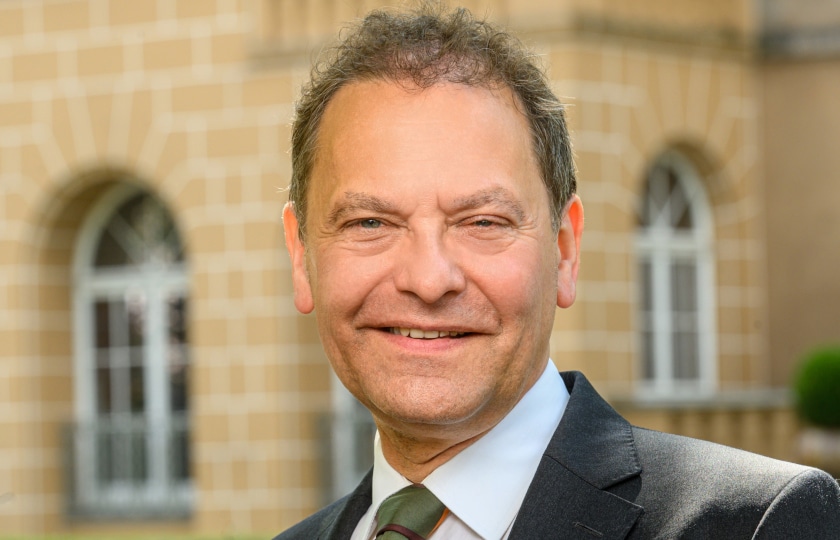
Dr. Hans-Ulrich Wagner

Dr. Hans-Ulrich Wagner

Head of the Research Group Media History

Leibniz Institute for Media Research, Hans-Bredow-Institut (HBI)
Warburgstraße 30 B
20354 Hamburg

Similar projects & publications

Cover Stellungnahme Digitale Medien-Staatsvertrag
Available for Download

Expert Opinion on the State Treaty on Digital Media, Part 2

Wolfgang Schulz, Stephan Dreyer, Jasmin Hamid Habib, Matthias C. Kettemann, and Tobias Mast comment on the proposal by the State Broadcasting Commission regarding the “State Treaty on Digital Media, Part 2” (DMStV) in an expert opinion on the planned reform of the State Media Treaty and the State Treaty on the Protection of Minors in the Media.

First page of the article: The German Media Landscape Under the Control of Global Intermediaries
Article in Media Perspektiven

The German Media Landscape Under the Control of Global Intermediaries

The German media industry is growing, but it is primarily international platform companies that are benefiting from this trend. In the journal "Media Perspektiven", Lukas Barbutev, Tobias Mast, and Hendrik Theine analyze the consequences of the increasing market power of Google, Meta, and Amazon for the German media landscape.

Cover of the journal
Recently Published

M&K 3–4/2026 Has Been Published

The articles in issue 3–4/2026 of M&K address the architectural paradox of federated platforms (Simon Crins), a comparative analysis of media use among Danish and German police officers (Jochen Kinast / Johannes Riis, in English), and an exploratory typology of German fact-checkers (Johanna Radechovsky). All articles are available for download free of charge.

Cover of the journal "Journalism"
Open Access Publication

Arms Deliveries to Ukraine: Viewpoint Diversity in German Media

Gregor Wiedemann, Laura Liebig, and Katharina Kleinen-von Königslöw examined how German leading media outlets covered arms deliveries to Ukraine. Using AI-assisted content analysis, they evaluated articles from 14 leading German media outlets published in 2022 and 2023.

Cover des Routledge Handbook of News Agencies
Chapter in Routledge Handbook of News Agencies

The German Press Agency in the Routledge Handbook of News Agencies

Hans-Ulrich Wagner summarizes the key facts and the history of the German Press Agency (dpa) in his contribution. From its founding in the postwar period to the present day, he describes the agency’s defining values and principles, as well as the challenges it currently faces.

Cover of issue 14 / 2026 of the journal "Media and Communication"
Open Access Publication

Can the Quality of Online Discussions Be Automatically Assessed—and Improved?

In their publication, Patrick Frey, Cornelius Puschmann (ZeMKI, University of Bremen), Smita Bhattacharya, and Gregor Wiedemann (HBI) explore whetherAI can measure the quality of online discussions. The study demonstrates that AI can identify violations of norms and serve as a tool for crafting counterarguments tailored to specific debates.

Cover of the current issue of the magazine “KJug” (3/2026)
New KJug Issue Has Been Published

Protecting Children and Young People in an Increasingly Digitalized World

In the latest issue of KJug, Claudia Lampert presents the EU Kids Online research consortium's findings on how children and adolescents view a potential social media ban. Kira Thiel shares insights from her dissertation, which examines how adolescents cope with problematic online experiences and the strategies they use to manage them.

Nonfiction Book Cover: No Child's Play
Recently Published!

No Child’s Play – Protecting Minors in the Digital Age

In his nonfiction book, Stephan Dreyer analyzes the complex field of youth media protection. Through his examination of legal regulations, actual usage, and technological developments, he offers valuable insights for individuals involved in this topic in the realms of practice, administration, politics, and academia.

Zwei Jugendliche, zu sehen von hinten oben, sitzen auf einer Mauer und blicken auf ein Handy
New DFG Research Project

Safeguarding Epistemic Trust in Adolescents: Conceptual Approaches and Policy Options

The interdisciplinary DFG project, “SETA: Protecting the Epistemic Trust of Adolescents: Conceptual Approaches and Policy Options,” conducted in collaboration with the Weizenbaum Institute, examines the state’s obligation to protect the epistemic trust of 13- to 17-year-olds without infringing on freedom of expression and information.

Cover des Arbeitspapiers Reuters-Bericht 2021
Report for Download

Reuters Institute Digital News Report 2021

The Reuters Institute Digital News Report, which provides an international comparison of news consumption, is being published for the tenth consecutive year.

1 2 3 … 36

Page 1 from 36

Newsletter

Information about current projects, events and publications of the institute.

Subscribe now